
Imagine if every shipment in your company could be tracked moment by moment, with shipping routes optimized automatically and manual errors reduced—or even eliminated entirely.
If you are responsible for logistics operations for one or multiple companies, or a 3PL service provider, whether in e-commerce or any general business aiming to improve transportation management, this guide is made for you. Here, we will provide a roadmap and a framework for choosing the best Cloud-Based TMS, along with a comparison of the leading platforms, detailed reviews for each system, and tips to avoid mistakes that could cause unnecessary problems.
After reading this article, you will have a clear understanding and know exactly which system fits your company’s size and budget.
Table of Contents
What Is a Cloud-Based TMS?
A Cloud-based Transportation Management System (TMS) is a logistics software system of the SaaS type, hosted on remote servers instead of being installed locally on the company’s site or on company-owned infrastructure. This system allows you to register shipments and monitor their movements, as well as track goods flow, through a web interface designed for smooth operation and speed, or via a mobile app.
Who Needs a Cloud TMS?
It is very important to understand who has a real need for a Cloud-based TMS and whose operations require complex logistics planning. Below are the main types of companies whose business requires this system as part of their operational structure:
- 3PL Logistics Providers: They need a 3PL transportation management system to manage multiple clients at the same time, track shipments, and handle automated billing.
- Retailers and multi-channel commerce: Usually medium-sized companies that need fast order delivery and inventory synchronization.
- E-commerce companies: Also typically medium-sized businesses that want to handle returns and maintain competitive delivery points.
- Large institutions: Use a Cloud-based TMS to unify workflows. Their operations require advanced analytics and integration with ERP/WMS systems.
- Factories and distribution: Benefit from full shipment visibility and reduced transportation costs and delays.
- Multimodal Shippers: These are large companies that manage shipments by land, sea, and air, and they need a single unified system to manage all operations.
Best Cloud-Based TMS Platforms & Buyer’s Guide
With so many platforms offering a Cloud-based TMS, most companies—especially small and medium-sized businesses—often struggle to choose the platform that best fits their needs. That’s why we have gathered the top Cloud-based Transportation Management System platforms. We selected these platforms based on our team’s experience and user reviews and ratings. We also included a buying guide for each platform, showing which type of company it suits best.
Note: The order of the platforms does not indicate that one platform is better than another.
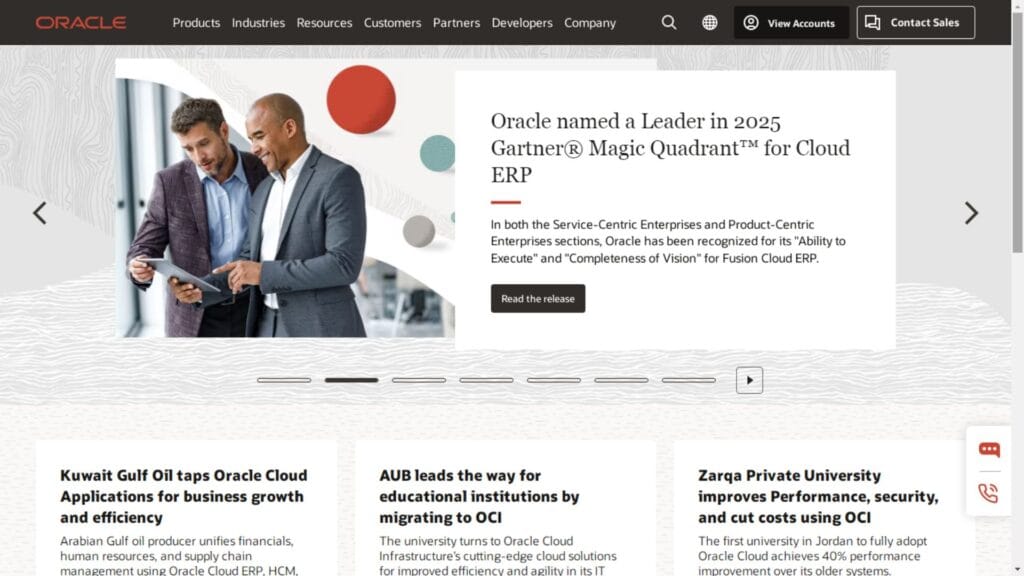
Oracle: It is a Cloud-based Transportation Management System (TMS) designed to provide suitable planning and execution, and to optimize shipping and logistics operations—whether by sea, land, air, or rail—based on the company’s requirements. It also integrates payment systems and customs compliance, all within a single platform.
Pros
- Excellent integration within the Oracle ecosystem
- Provides comprehensive logistics support (sea, land, air, and rail)
- Generates detailed reports and insights
- Smart AI-powered forecasting
Cons
- Very high cost
- The platform is complex and requires time to adapt to its workflow
- Limited customization compared to competitors
- It requires large resources and significant infrastructure capacity
Pricing Plans:
Oracle does not provide fixed pricing for its platform. The company sets prices based on the client’s needs, determined by several factors: the number of shipments, additional features, and contract duration. Pricing and services are negotiated directly with Oracle or its authorized partners, such as Elfonze Technologies and Trinamix, among others. Additional costs may apply, including implementation, customization, training, and ongoing technical support. Oracle does not offer any free version or trial of the system.
Buyer’s Guide:
Large enterprises and multinational corporations: As mentioned earlier, it is designed for companies that require multimodal transportation (land, sea, air, rail). Its ability to handle complex environments makes it particularly suitable for large organizations.
Companies needing deep integration with ERP/WMS systems: Oracle integrates seamlessly with ERP, SCM, and WMS systems, making it ideal for businesses that want smooth data transfer between systems without manual intervention—though some supervision and occasional manual input may still be required.
Companies aiming to improve planning and strategic decisions: Suitable for those seeking advanced analytics, fast forecasting powered by AI, and optimization of transportation routes.

Kuebix: Currently tracking FreightWise, it is a Cloud-based TMS that provides solutions for land, sea, and air transportation. It manages shipments and improves operational workflows through a centralized logistics platform.
Pros
- Easy and user-friendly interface
- Supports multiple transportation modes such as LTL (less-than-truckload), FTL (full truckload), parcel, and intermodal
- Can integrate with carriers and delivery networks via API and EDI with ERP/WMS systems and others
Cons
- Customer support can be slow at times
- Some reports are basic
- Occasional technical issues may appear
Pricing Plans:
OnKue (Entry Level): $69/month – 100 quotes per month – 1 location, 1 user – supports LTL, Parcel, and Truckload – first two months free
OnKue (Mid Tier): $253/month – includes up to 5 locations or users – 400 shipment quotes per month
Business Pro: The full version of Kuebix – unlimited users – unlimited quotes and shipments – high-level support – pricing is customized based on company requirements
The tool offers a free plan or a light level for beginners
All prices are subject to change over time. Please check carefully before completing your payment.
Buyer’s Guide:
Small and Medium Businesses (SMBs): Kuebix is particularly suitable for small and medium-sized companies that need a Cloud-Based TMS without excessive complexity. Choosing the right plan is important— for a single location, OnKue Basic at $69/month is a practical option.
Growing companies needing scalability: Kuebix works well for businesses looking to expand internationally in a controlled way. Companies planning gradual growth over a longer timeline can benefit from the Business Pro plan to build analytics and reporting based on their vision and company strategy.
Companies focused on controlling shipping costs: Kuebix is ideal for those seeking to manage shipping expenses and improve financial efficiency without requiring huge investments or overly complex plans.

SAP: An advanced system for managing transportation and logistics services, designed to increase operational efficiency, manage fleets, and automate shipping processes.
Pros
- Increases operational efficiency for the company
- Supports collaboration between parties (shippers, carriers, and distributors)
- Good integration with SAP systems and seamless data flow
- Flexible and scalable to support business growth
Cons
- The interface can be difficult to learn, especially for new users, requiring training sessions
- Somewhat high maintenance costs
Pricing Plans:
SAP does not offer fixed pricing. Instead, the company customizes costs based on the company’s annual spending, considering the business size, implementation, and operational processes. Additional expenses may apply. Pricing details are provided upon request from SAP.
Buyer’s Guide:
Large companies and multi-branch organizations: SAP is suitable for companies with complex networks that require comprehensive planning.
Companies already using SAP ERP / S/4HANA: If a company relies on SAP S/4HANA or other SAP solutions like EWM or Global Trade Services, the tool integrates seamlessly and provides highly organized and efficient data management.
Companies handling international transport and cross-border compliance: The system is strong in managing regulations and international transport compliance, providing customs documentation and ensuring legal adherence.
Integrated transportation and logistics service providers (such as Freight Forwarders and 3PLs): Although primarily designed for large enterprises, it can also serve advanced transport service providers, especially those needing integration with SAP ERP.
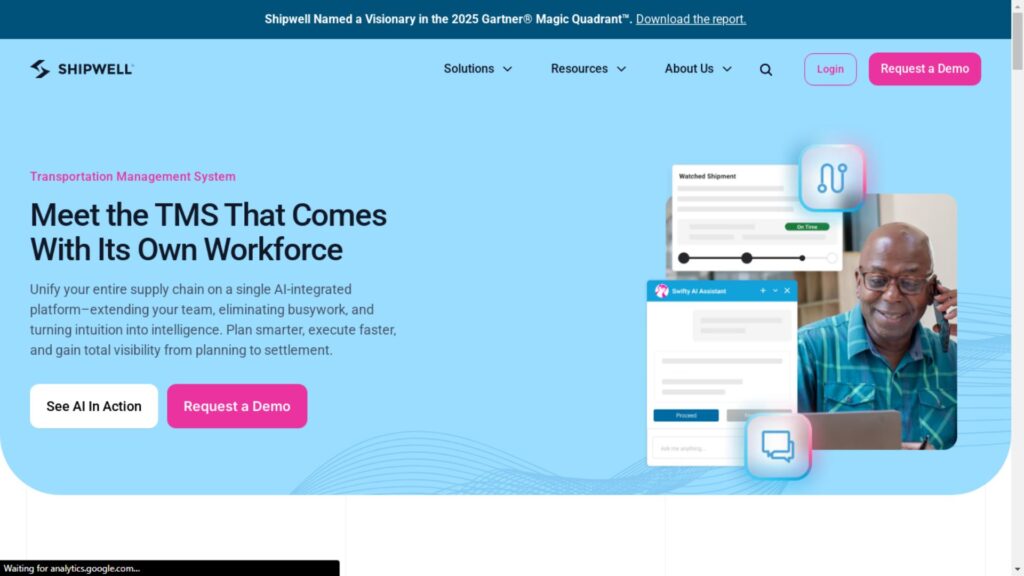
Shipwell: is a platform that relies heavily on AI and aims to simplify shipping, tracking, planning, and freight transportation across multiple modes. It provides comprehensive solutions that connect shippers with carriers.
Pros
- It brings all business functions together in a single interface (easy to manage)
- Provides real-time visibility of shipments (their status and tracking)
- Highly scalable and integrates with multiple systems such as ERP, WMS, and others through robust API interfaces
Cons
- Occasional software issues may occur, which can impact workflow
- The cost is somewhat high for small companies
Pricing Plans:
Shipwell does not provide clear or fixed pricing. While it does use a SaaS model with monthly or annual payments, its pricing structure depends on the company’s requirements and size, such as the number of shipments, transportation volume, data usage, and similar factors. To determine the exact fees, companies need to contact the Shipwell team and negotiate the pricing details directly.
Approximately: ≈ $1,000/month as a starting subscription price (estimated).
This figure is based on statements from platform users, and there is a trial period included in some offers.
Buyer’s Guide:
Medium to large logistics transportation companies: Shipwell is suitable for them because it manages complex transportation networks similar to the operations of large enterprises.
Businesses that want to reduce manual work: The platform relies heavily on artificial intelligence, which helps reduce human effort; however, human oversight is still required from time to time.
Descartes: It is a leading SaaS platform specialized in supply chain management, logistics services, and international transportation. It relies heavily on connecting trading partners and providing real-time shipment tracking.
Pros
- The tool is specifically designed for 3PL shipping agents.
- Provides high-level market analysis and forecasts.
- Tracks shipments in real-time and shows their status.
Cons
- The design is outdated if medium or large companies decide to use it.
- Support may not respond excellently to requests, especially if something is complex for the company’s workflow.
Pricing Plans:
Essential Plan: $500/month, includes up to 5 users, provides shipment status visibility, and MyCarrierPortal integration.
Professional Plan: $999/month, includes 15 users, 1 EDI connection for clients, and Descartes Analytics.
Enterprise Plan: $2,375/month, includes all previous features and multiple EDI connections.
The tool does not offer any free or trial period, so users must be professionals, not beginners, especially given its high pricing.
All prices are subject to change over time. Please check carefully before completing your payment.
Buyer’s Guide:
3PL Providers: The tool offers real-time monitoring of shipments and their current status.
Freight Brokers: Descartes supports managing multiple campaigns and optimizing shipping costs, making it suitable for shipping agencies, particularly those working with multiple carriers.
Here, we have reviewed the best Cloud-based Transportation Management System platforms based on user feedback and our team’s experience in the field. After reading, you should have a clear idea of which tool suits your type of company—whether you are a small business, a medium-sized company, a large enterprise, or a 3PL service provider. Since we focus on supporting the growth of small businesses, we recommend Kuebix for them because of its low budget requirement, which is a common challenge for most startups. Even if the reports it generates are basic, small companies usually do not need in-depth analysis.
All prices are subject to change over time. Please check carefully before completing your payment.
Conclusion: Cloud-Based TMS
Today, Cloud-Based TMS has become an essential tool for any company whose core business involves transportation and logistics. With the availability of modern logistics platforms and tools, industry professionals now rely on specialized providers—regardless of whether their services are expensive or not. Compared to On-premise TMS, solutions from specialized companies offer stronger security and much greater scalability.
In this guide, we explained who needs cloud-based TMS systems, how to choose the right platform for your business type, and reviewed the best companies available in the market.
In the end, choosing the right platform depends on your company’s size and budget. Selecting the system carefully can support business growth, enhance security, and reduce overall costs.
FAQ
-
What is cloud based TMS software and how does it work?
Cloud-based TMS software is a transportation management system hosted online instead of on local servers, allowing companies to track shipments and their status, as well as monitor movement through a user interface on both web and mobile.
-
What is the best TMS software for logistics companies?
Choosing a transportation management software depends on the company’s size, budget, and nature of operations. For small and medium-sized companies or those with a limited budget, Kuebix is an ideal platform. On the other hand, platforms like Oracle or SAP are more suitable for large enterprises with extensive operations.
-
How is a cloud based TMS different from a shipment management system?
A cloud-based transportation management system focuses on managing the entire transportation process, including planning, route optimization, and analytics. In contrast, a shipment management system focuses on tracking and managing individual shipments without offering full operational planning or optimization features.